보유장비 (R&D Facility)
윤활유, 나노유체, 액체의 열전도도, 비열, 열확산율 측정기
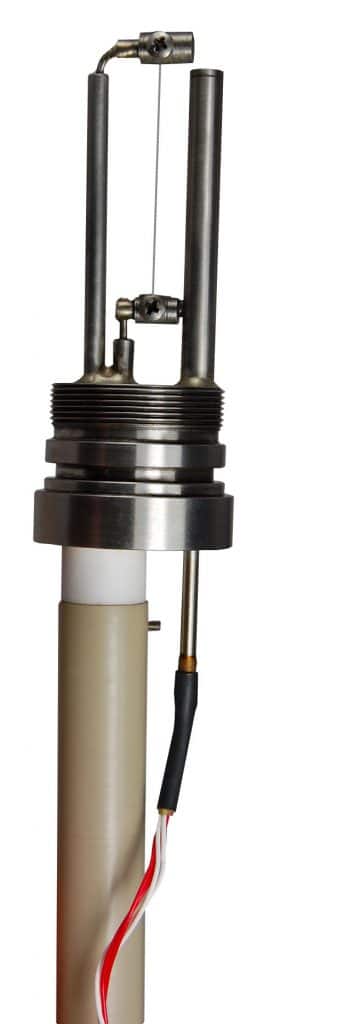
ASTM D7896-19에 따른 열선법을 사용하여, 넓은 온도와 압력 범위에서 열전도도와 열확산율, 비열을 신속하게 측정 하는 사용자 친화적 Transient Hot Wire (THW) method의 열전도도측정기입니다. 본 제품의 우수성은 유체의 대류현상 없이, 정확하고 재현있는 열전도도 측정하는 데 있으며, 실험실과 현장에서 nanoparticle dispersion 및 나노유체, 열유체, 절연유의 정확한 열전도도의 측정이 가능합니다.

Key features
- 고정밀 연구 장비
- 넓은 열전도도 측정 범위(10~2000mW/mK)
- 온도의 함수로써 열전도도 측정
- Hot Wire 기법을 따른 instationary resistance 측정
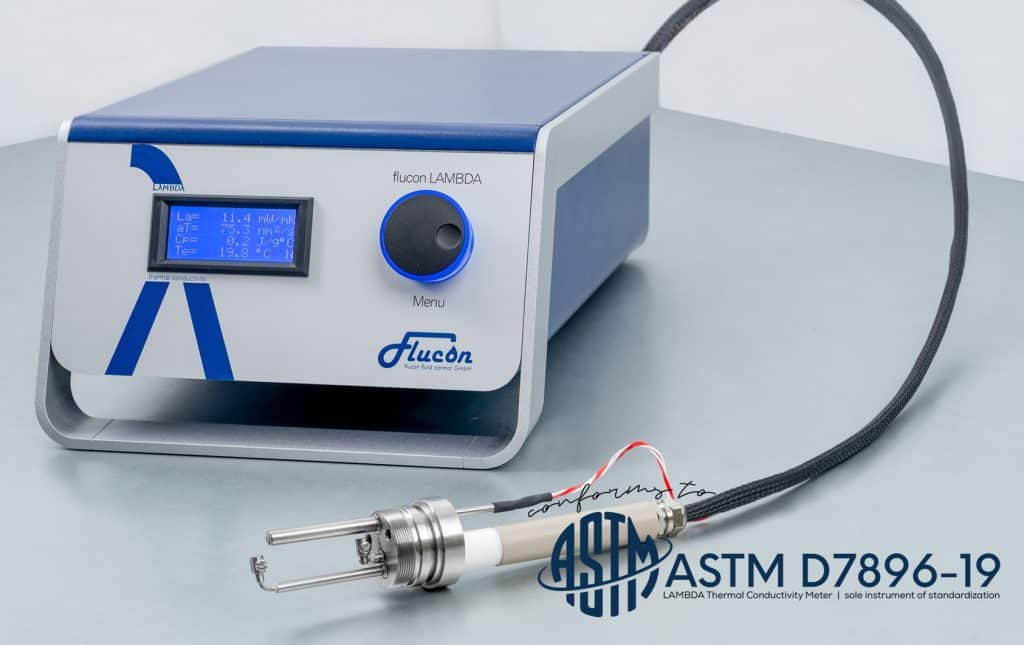
- ASTM D7896-19에 일치
- 견고한 스테인리스 스틸 센서 사용
- 넓은 온도 범위(실온~300°C)
- Convection의 영향 없이 빠르고 정확하게 측정
- 모든 유체와 분말 또는 젤에 적용가능
- 소량의 샘플 사용(40ml)
- 뛰어난 재현성(±1%)
- 짧은 설정 시간
- 빠르고 쉬운 작동법
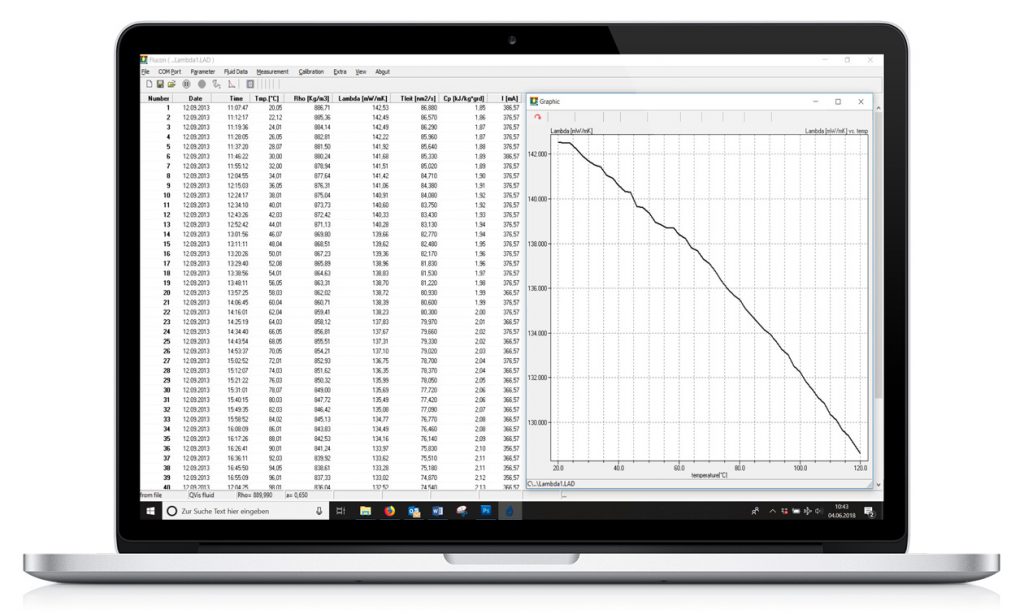
- PC 소프트웨어에 의한 자동 온도 조절 및 열전도도의 측정
- 뛰어난 기능의 LAMBDA 소프트웨어 포함
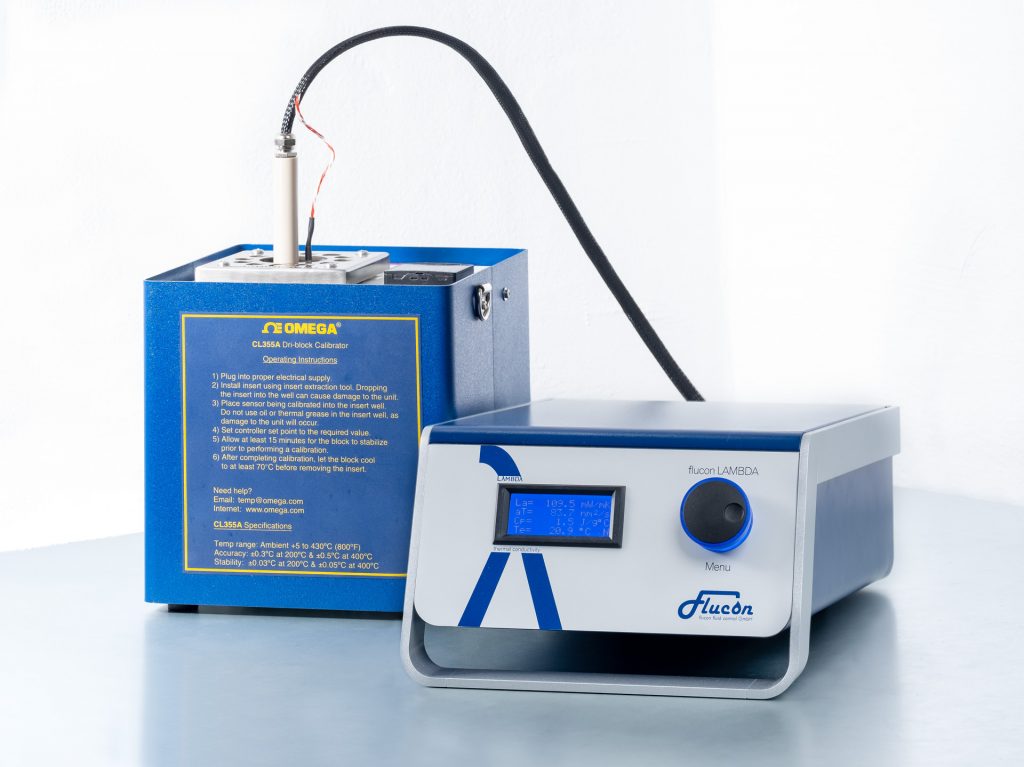
- 자동으로 샘플의 온도를 조절하기 위한 thermostat 옵션 가능
Modes of operation
Automatic sample temperature control
실온~300°C
Technical data
|
Suitable media |
fluids, gels, powders |
|
Sample quantity |
approx. 40 ml |
|
Test standard |
conforms to ASTM D7896-19 based on ASTM D2717 |
|
Measuring range |
10 to 2,000 mW/(m*K) |
|
Repeatability limit |
1 % |
|
Temperature range - sensor |
-50°C to 300°C |
|
Temperature accuracy |
± 0.1 K |
|
Temperature measurement |
PT100 |
|
Pressure range - sensor |
0 to 35 bar (optional HP version up to 500 bar available) |
|
Measuring time |
approx. 60 s |
|
Connectivity |
RS-232 interface (adaptable to USB) |
|
Display |
LCD (4 x 16 digits) |
|
Dimensions electronic unit (LxWxH) |
370 x 235 x 150 mm |
|
Weight - system |
approx. 2.9 kg |
|
Power supply |
110 - 240 V AC, 50/60Hz |
|
Energy consumption |
15W |
|
Outer dimensions sample vessel (screw-on cup) |
D = 38 mm (equals inner diameter of thermostat jacket); L = 110 mm (equals immersion depth into thermostat) |
|
Optional accessories |
Dry-block thermostat for automatic testing above RT Fluid circulator w/ extra vessel for testing below RT |
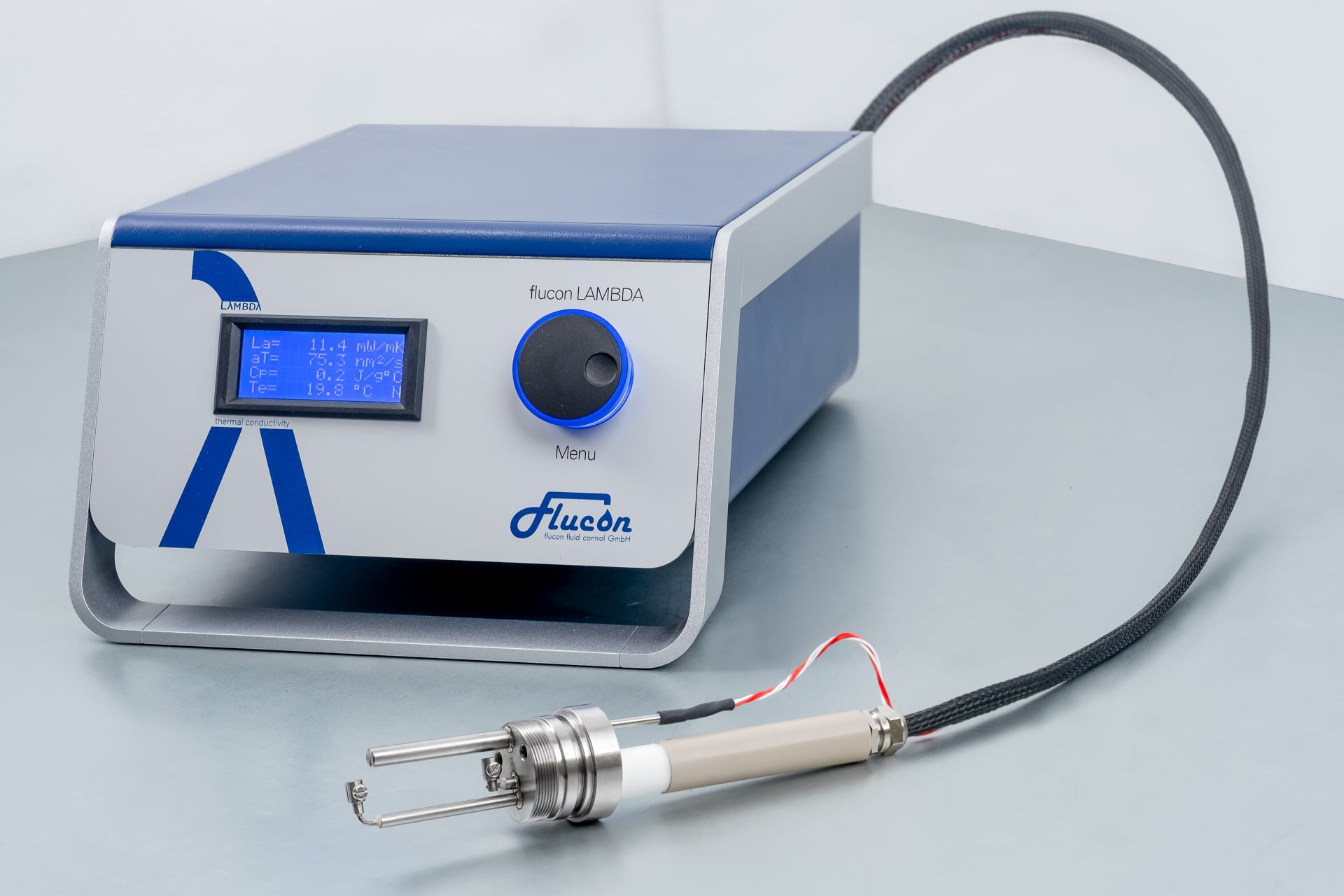
LAMBDA is a compact, operator-friendly transient hot wire instrument that facilitates a fast determination of the thermal conductivity in a wide temperature and pressure range by means of the hot wire method according to ASTM D7896-19. This highly accurate athermal calorimeter is suited for fluid analysis in the laboratory as well as in the field, including the measurement of thermal conductivity of nanoparticle dispersions/nano fluids. The LAMBDA thermal conductivity meter can be operated either in stand-alone mode or with the intuitive software (incl.) on your WINDOWS computer via RS-232/USB.
Easy and fast measurement
For determining the thermal conductivity with LAMBDA a small sample volume of 40 ml is sufficient. Simply immerse its sensor with the hot wire into the sample and LAMBDA will determine the thermal conductivity as well as the temperature of your fluid in a one minute interval.
What is Thermal conductivity
The thermal conductivity lambda (λ) of a solid, a fluid or a gas may basically be understood as the speed at which a defined amount of heat travels as it goes through a particular substance. A low λ value means low thermal conductivity.
For both liquids and gases lambda highly depends on the temperature, whereas pressure dependence is comparitively low. The measure for lambda is W/(m*K) (Watts per Meter and Kelvin).
Typical lambda values for different fluids
| Fluid | Thermal conductivity λ (W/(m*K)) |
| gasoline | 0,140 |
| glycerin | 0,286 |
| machine oil | 0,126 |
| ethanol | 0,185 |
| water @ 10°C | 0,580 |
| water @ 60°C | 0,644 |
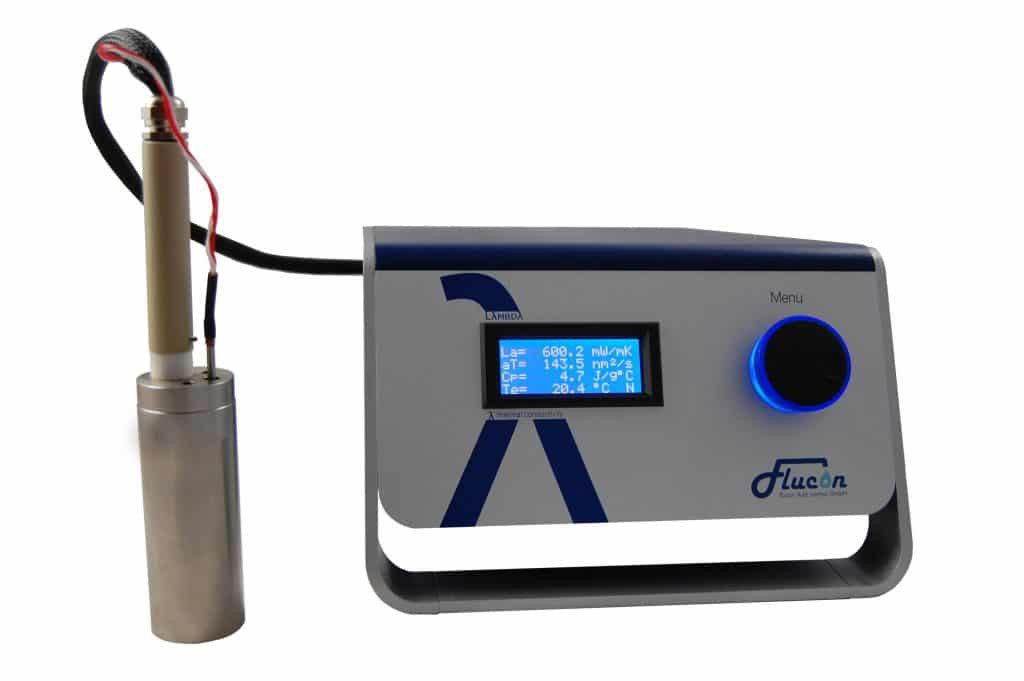
Workflow for the determination of the thermal conductivity (flucon fluid analysis)
flucon not only offers their portable LAMBDA measuring system but also in-house fluid analysis in our own high pressure laboratory. Customers may send in small samples (300 ml) of the fluid they would like to have tested and then the following steps will be performed:
- Laboratory measurement of the thermal conductivity as a function of temperature and pressure using a transient measuring method preventing an influence of convective flow of heat on the measuring result
- Mathematical description of the pressure/temperature-dependant thermal conductivity
- Graphical data preparation
Fundamentals of measuring λ
Stationary vs. instationary method
There are two ways of measuring thermal conductivity: the stationary and the instationary method. The stationary method is principally simpler as it proceeds from a constant temperature level, whereas the instationary method takes the problem of a changing temperature field into account. There is an advantage resulting from this extra effort however: the instationary method provides measuring results for the thermal conductivity much faster and the results are less influenced by convection.
The effects of convection for the stationary method
According to POLTZ the stationary method is seriously hampered by the fact of thermal conductivity induced by convection. In Tuluol, for example, an average flow rate of only o.01 mm/min leads to a deviance of about 1% in the data obtained for the thermal conductivity due to free convection. Therefore, POLTZ concludes that the stationary method, especially in an experimental set-up where the thick layers are concerned, cannot provide measuring data without a noticeable influence of convection. Furthermore, great care must be taken to avoid any kind of forced convection, such as would be caused by vibration of the measuring apparatus.
Measuring lambda. With LAMBDA.
The LAMBDA Thermal Conductivity Meter developed by flucon will give you the advantages of the fast instationary transient hot-wire method while at the same time excluding the influence of convection in the measuring process. This is achieved by computational processing of the data obtained within very short periods of time (approx. 800 ms) which in turn leads to a very short over-all duration of the test process (approx. 60 s).
The hot-wire of the LAMBDA serves as the source of heat and as the transducer at the same time. In order to raise the temperature, the hot-wire is subjected to a constant measuring current; as the surrounding medium warms up, the resistance of the hot-wire will change in accordance with the thermal viscosity of the surrounding medium. Thus the change of voltage in the hot-wire indicates the change of temperature taking place in the surrounding medium.

-
2026년 8월 현재, 서비스 가능합니다.윤활유, 나노유체, 액체의 열전도도, 비열, 열확산율 측정기YEONJIN S-Tech Corporation 2026-09-03 10:54:54
-
2026년 8월 현재, 서비스 가능합니다.DSC Advanced Model-Free Kinetics 측정분석 서비스YEONJIN S-Tech Corporation 2025-10-29 18:04:24
-
2026년 8월 현재, 서비스 가능합니다.DSC Model Free Kinetics 측정분석 서비스YEONJIN S-Tech Corporation 2025-10-29 18:05:17
-
2026년 8월 현재, 서비스 가능합니다.DSC nth Order Kinetics 측정분석 서비스YEONJIN S-Tech Corporation 2025-10-29 18:05:46
0개 댓글